Planning an event at an outdoor venue sounds simple. Find a beautiful property, bring in the tables and chairs, hire the caterer, decorate the space and let the scenery do the rest.
But anyone who has actually planned an outdoor wedding, corporate event, private party or large gathering knows there is a lot more involved.
An outdoor venue doesn’t come with walls, permanent bathrooms, climate control, built-in lighting or an unlimited supply of electricity. Every one of those things has to be considered before the first guest arrives.
And that’s where outdoor events can get complicated.
The good news? With the right planning, an outdoor venue can create an incredible guest experience that an indoor venue simply can’t replicate.
Here’s the outdoor venue survival guide covering the details that are easy to overlook—and the things you should ask about before committing to a location.
1. Don’t Fall in Love With the View Before Checking the Logistics
This might be the biggest mistake people make when choosing an outdoor venue.
The photos look incredible. There’s a beautiful waterfront, sprawling property, vineyard, barn, garden or private backyard. You can already picture the ceremony happening there.
But before booking, take a step back.
Ask yourself:
- Where will guests park?
- How far is parking from the event area?
- Where will vendors unload?
- Can a delivery truck actually access the property?
- Where will power come from?
- Where are the washrooms?
- Is there somewhere for caterers to work?
- What happens if it rains?
- What happens if temperatures suddenly change?
- Is the ground suitable for tables, chairs and foot traffic?
- Where will garbage and recycling go?
- Is there adequate lighting after sunset?
An outdoor venue needs to be evaluated as a working event site, not just a pretty backdrop.
A beautiful venue with poor logistics can create more stress than a less picturesque venue that was designed specifically for events.
2. Your Rain Plan Should Exist Before You Book the Venue
Here’s something planners don’t always emphasize enough:
A rain plan isn’t just a tent.
If your outdoor venue becomes saturated after heavy rain, the problem isn’t necessarily the sky above you. It’s what’s happening underneath your guests’ feet.
Grass can become muddy. Gravel can become difficult for certain footwear. Pathways can become slippery. Vehicles can have trouble accessing the property.
That’s why your backup plan should consider the entire event layout.
Where does the ceremony move?
Where does dinner move?
Can vendors still access the site?
Can guests get from parking to the tent without walking through mud?
Will the caterer still have a suitable workspace?
Outdoor wedding planning guidance recommends thinking about weather contingencies early, including the possibility of tents and ground conditions—not simply waiting until the forecast changes.
A good outdoor venue should have a Plan B.
A great one has a Plan B that you’ve actually walked through.
3. Weather Doesn’t Mean Just Rain
When people think about outdoor event weather, they usually think about rain.
But outdoor events have several other weather variables to consider.
Heat
A beautiful sunny day can become uncomfortable surprisingly quickly.
Consider:
- Shade structures
- Water stations
- Fans
- Covered seating
- Sunscreen
- Cooling areas
- Timing your ceremony around peak afternoon heat
Wind
Wind can cause its own set of problems.
Loose signage, menus, decorations, table numbers and lightweight décor can quickly become airborne.
Tents, umbrellas and other temporary structures also need to be appropriately secured.
Cold
Evening temperatures can drop quickly, particularly in spring and fall.
If your event continues after sunset, think about guest comfort before the temperature drops.
Heaters, blankets and enclosed areas can make a significant difference.
Insects
Outdoor venues naturally come with outdoor guests—mosquitoes and other insects included.
Depending on the location and season, consider insect management, food protection and guest comfort.
The goal isn’t to eliminate every outdoor variable.
It’s to plan for them instead of being surprised by them.
4. Restrooms Are One of the Most Important Parts of Your Outdoor Venue
Let’s talk about the elephant in the room.
Or, more accurately, the restroom.
When you’re planning an outdoor event, restrooms can be one of the easiest things to overlook because they’re not nearly as exciting as the venue, décor or catering.
But your guests will notice them.
And they’ll notice immediately if the facilities are inadequate.
Ontario guidance for outdoor venues emphasizes the importance of appropriate toilet facilities, regular maintenance and hand-cleaning provisions.
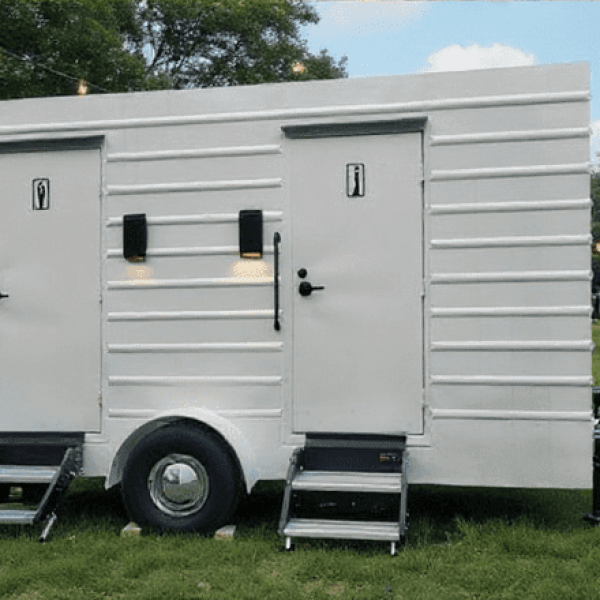
If your outdoor venue doesn’t have enough permanent washrooms, a luxury restroom trailer can provide a much more comfortable alternative to relying solely on basic portable toilets.
A restroom trailer can offer:
- Separate men’s and women’s facilities
- Flushing toilets
- Interior lighting
- Mirrors
- Handwashing facilities
- A more comfortable, private environment
- A setup that feels appropriate for weddings and upscale events
At Toiluxe, this is exactly what we focus on: bringing a clean, comfortable hotel inspired restroom experience to outdoor venues throughout our service area.
The restroom may not be the first thing guests compliment about your event—but a great one can quietly make the entire experience feel more polished.
5. Don’t Forget About Power
Outdoor venues frequently have limited electrical infrastructure.
Before booking vendors, determine exactly what power is available.
Your event might require electricity for:
- Catering equipment
- DJ equipment
- Bands
- Lighting
- Refrigeration
- Bar equipment
- Restroom trailers
- Decorative lighting
- Audio equipment
Don’t simply ask, “Does the venue have power?”
Ask:
How much power is available, where is it located, and what else will be using it?
If the venue doesn’t have sufficient electrical capacity, a generator may be necessary.
And if you’re using multiple vendors, make sure everyone knows who is responsible for supplying power.
Outdoor event planning resources commonly recommend confirming power requirements with vendors well before the event date.
6. Think About Guest Transportation and Accessibility
An outdoor venue can look relatively small on a map but feel enormous on event day.
Consider the distance between:
Parking → Ceremony → Cocktail Hour → Dinner → Restrooms
If guests need to walk several hundred feet between locations, that matters.
So does the surface they’re walking on.
Grass, gravel, sand, uneven terrain and steep slopes can all affect accessibility.
Think about older guests, guests using mobility aids, parents with young children and anyone wearing formal footwear.
An outdoor venue should be beautiful—but it should also be practical.
7. Lighting Becomes a Bigger Deal After Sunset
During the day, your venue may look incredible without any additional lighting.
Then the sun goes down.
Suddenly, pathways, parking areas, washrooms and food-service areas need illumination.
Don’t just think about decorative lighting.
Think about functional lighting.
Guests need to be able to safely navigate:
- Parking areas
- Walkways
- Restrooms
- Dining areas
- Steps
- Entrances and exits
Then you can layer decorative lighting on top.
String lights, lanterns and other decorative elements can create an incredible atmosphere, but they shouldn’t be responsible for providing all of the illumination your guests need.
8. Your Caterer Needs an Outdoor Plan Too
A caterer who is fantastic at an indoor venue may have very different requirements when working outdoors.
Ask about:
- Prep space
- Refrigeration
- Water
- Power
- Shelter
- Food protection
- Waste disposal
- Cooking equipment
- Loading access
Food needs to be protected from environmental conditions, and Ontario’s food-premises regulations include requirements around sanitation and protecting food from contamination.
Your caterer should know what they need.
Your job is making sure the venue can provide it—or arranging the necessary rentals.
9. Parking and Vendor Access Can Make or Break Your Day
This is one of those details that seems insignificant until event day.
Imagine 100 guests arriving within a 20-minute window.
Now imagine:
- One narrow driveway
- Limited parking
- A catering truck arriving
- A DJ unloading equipment
- A restroom trailer delivery
- Guests arriving at the same time
Suddenly, your beautiful outdoor venue has a traffic problem.
Create a simple arrival and loading plan.
Ideally, vendors should have a designated loading area and enough access to get their equipment where it needs to go before guests arrive.
10. Ask What Happens After the Event
The event doesn’t end when the last guest leaves.
Someone still needs to deal with:
- Garbage
- Recycling
- Food waste
- Rental equipment
- Decorations
- Tables and chairs
- Temporary structures
- Restroom servicing
- Site cleanup
Find out exactly what your venue includes.
Some venues provide comprehensive cleanup.
Others expect the event organizer to handle everything.
Neither option is necessarily wrong—but you don’t want to discover the difference at midnight.
11. Build an Outdoor Venue Checklist
Before signing the contract, walk through this list with your venue coordinator:
Venue
☐ Confirm maximum guest capacity
☐ Confirm parking capacity
☐ Confirm vendor access
☐ Confirm setup and teardown windows
☐ Confirm rain plan
☐ Confirm tent restrictions
☐ Confirm noise restrictions
☐ Confirm lighting requirements
Restrooms
☐ Confirm existing restroom capacity
☐ Determine whether additional facilities are required
☐ Confirm handwashing facilities
☐ Confirm restroom delivery/access requirements
☐ Confirm servicing and removal schedule
Power
☐ Determine available electrical capacity
☐ Identify electrical connection locations
☐ Ask vendors about power requirements
☐ Determine whether a generator is required
Weather
☐ Establish a rain plan
☐ Plan for heat
☐ Plan for cold
☐ Consider wind
☐ Consider insects
☐ Monitor the forecast as the event approaches
☐ Guest Experience
☐ Provide clear signage
☐ Consider accessibility
☐ Provide adequate lighting
☐ Plan comfortable seating
☐ Provide water
☐ Consider shade
☐ Make restrooms easy to find
12. The Secret to a Successful Outdoor Venue Event
Here’s the thing planners may not tell you:
- The best outdoor events don’t feel like a collection of temporary solutions.
- They feel intentional.
- The tent doesn’t feel like an emergency response to rain.
- The restroom doesn’t feel like an afterthought.
- The generator doesn’t feel like a last-minute problem.
- The lighting doesn’t feel improvised.
- The parking doesn’t feel chaotic.
- Everything simply works.
That’s the difference between an outdoor event that looks good in photographs and an outdoor event that actually feels good to attend.
And that’s ultimately what your guests remember.
Planning an Outdoor Event in Ontario?
If you’re planning a wedding, private party, corporate event or special gathering at an outdoor venue, don’t leave the practical details until the last week.
Start with the things your guests actually need: weather protection, comfortable restrooms, clean water, lighting, power, parking and easy access.
Then build the beautiful details around them.
At Toiluxe, we specialize in luxury mobile restroom solutions for outdoor events, helping planners create a more comfortable and polished guest experience when traditional restroom facilities aren’t available.
Because your outdoor venue should be remembered for the view, the food, the music and the celebration—not for the bathroom line.
Planning an outdoor event? Get in touch with Toiluxe to see how a luxury restroom trailer can fit into your event plan. Avoid costly site mistakes before signing your venue contract. Download our free, printable Outdoor Venue Survival Checklist—an essential walkthrough guide covering power loads, guest capacity, weather prep, and restroom facilities.
Helpful Outdoor Event Planning Resources
For additional planning and regulatory information, consult:
Government of Ontario — Outdoor Venues Safety Guidelines
Government of Ontario — Food Premises Regulation
BRIDES — Outdoor Wedding Planning Checklist & Timeline